
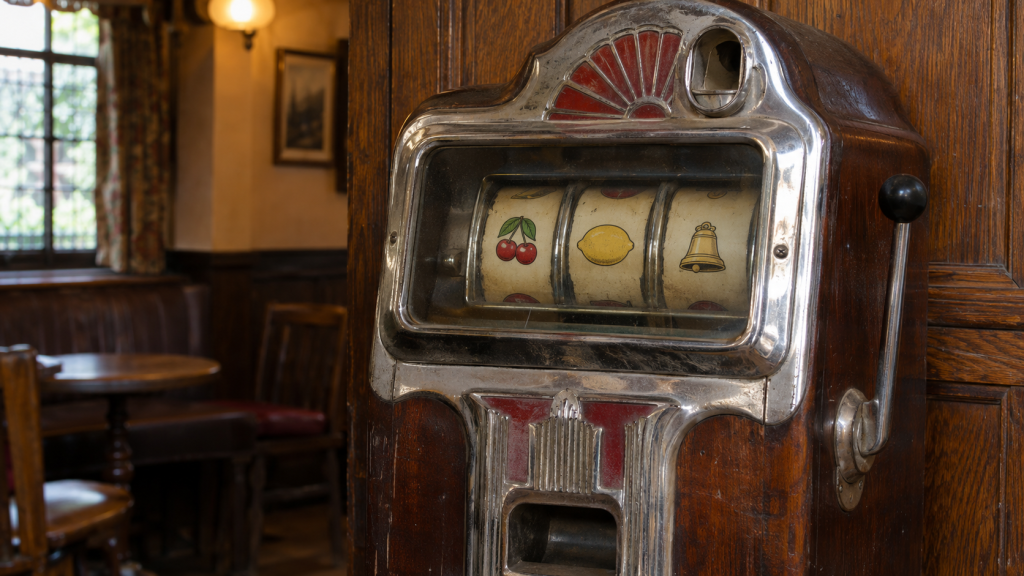
I write about food mostly, so fruit to me means crumbles and jam, which makes it a bit of a confession that I’d never once wondered why the machine by the door of my local has cherries on it. You don’t win cherries; you win coins, or more usually you don’t. Yet there they are, on every reel in every pub and arcade in the country. So I asked. The answer is dafter than I expected.
Where did fruit machines come from?
America is the short answer, and chewing gum is the longer one. The first machines were built in California in the 1890s: three reels and a bell on the winning line. Cities started banning them almost straight away, which is how the fruit got on. Around 1910 the Chicago makers, Mills Novelty being the big name, bolted a gum dispenser onto the side and swapped the symbols for fruit to stand for the gum. Officially you were buying gum. The dodge held for a few years and the fruit never left.
We didn’t have a word for them here until the 1930s, when “fruit machine” turned up in print, and for the next thirty years they were illegal everywhere. The 1960 Betting and Gaming Act finally let private clubs have two from New Year’s Day 1961, sixpence a go, and by December the Metropolitan Police had prosecuted 125 cases over machines being flogged into cafés and pubs ahead of the deadline, and had them destroyed.
Why cherries, lemons and lucky sevens?
So the cherries and lemons are gum flavours that outlived the gum, which I find oddly moving, and the bells are left over from that first California machine. The sevens I can’t give you a tidy story for: seven was already lucky and the designers used it. Melons and oranges are just more fruit.
A British entertainment institution
Once the clubs could have machines somebody had to build them, and in 1963 a firm in Lenton, Nottingham, did. Bell-Fruit Manufacturing started on tooling and bought off an American maker, and one of its first customers was Charringtons the brewery, which is why some early British reels had beer brands on them instead of fruit. Barcrest followed in Manchester in 1968, and between them the British makers came up with nearly everything that makes our machines different: the nudge, which bumps a reel one step and is usually credited to a small engineering firm in the late seventies; the hold button; and the stake gamble, patented in 1983 by a Cardiff designer called Arthur Thomas. An American slot never bothered with any of that.
The pub is where most of us meet them, and the pub version is tame on purpose. A landlord can have two just by telling the council, a pound a spin, a hundred pounds top prize, which is why a payout in a Yorkshire pub is a rattle rather than a siren. The seaside had them first. In 1899 an MP was on his feet in the Commons about indecent pictures in the penny-in-the-slot machines on Blackpool beach. Scarborough, usually listed as Britain’s first seaside resort and marking 400 years since its spa waters were found, has had them on the front among the 2p pushers for as long as I’ve been going.
From mechanical reels to digital screens
By the nineties the reels on a lot of pub machines were a video screen doing an impression of reels (Maygay did a Mario Kart one, which I’d have sworn was a false memory until I checked), and once the reels were a picture the walk to a phone screen was a short one. Nudges, holds and the stake gamble didn’t die with the cabinet. The current crop of popular online slot games has kept all three and added things a mechanical reel never could do, like symbols that pay for landing in a cluster anywhere on the screen.
What it hasn’t kept is the cap. The pub’s pound a go and hundred pounds back don’t apply online, where the stake is limited by the regulator but there’s no cabinet and no ceiling on the prize, and I’d want anyone to know that before they mistake one for the other because it’s got cherries on it. The seaside is going the other way, slowly: licensed family arcades fell from 220 in 2018 to 171 in 2024, and the government is still deciding whether the 2p pushers’ maximum stake can go from 20p to 30p.
The next chapter for slot games
I don’t think the pub machine is going anywhere. Plenty of pubs still have one, and there’s no app for the ten minutes between finishing a pint and deciding about the next. What’s changed is who has the ideas, and as far as I can tell it’s the online studios now. The Ting Tings put out a song called Fruit Machine in 2007, about being taken for a ride by the music business, which had passed me by until this week. I’ve had it on three times since.