
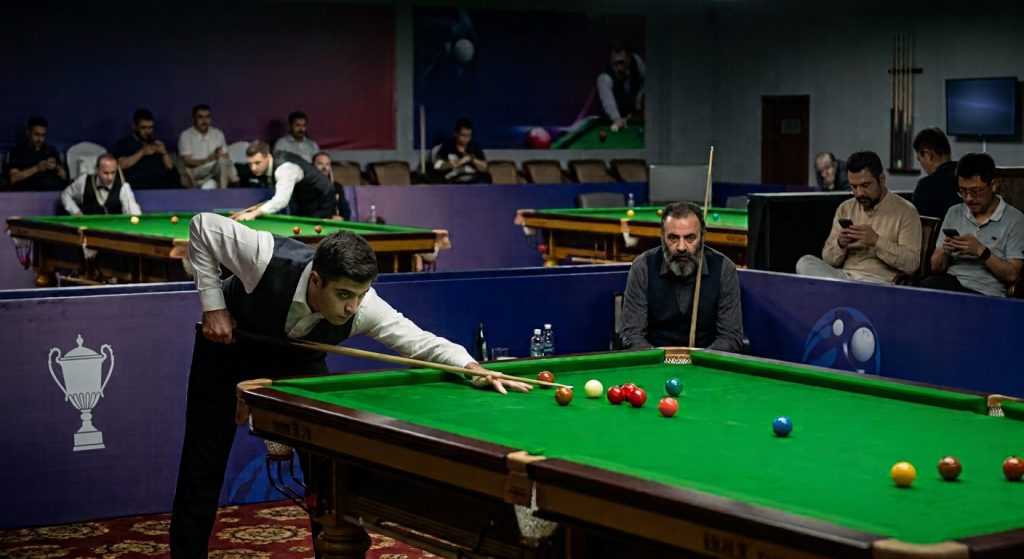
Snooker’s calendar is a grind. Players need serious stamina to get through it. And under some draw formats, even multiple ranking-event winners don’t get a free pass to the final venue. They often start in the qualifiers against lower-ranked opponents.
Delayed TV highlights only tell part of the story. Short qualifying matches attract betting interest too, with mobile apps such as onjabet دانلود providing access to sports betting on a phone while the tournament moves through its early rounds.
The tour has seen plenty of tactical shifts, and the pattern is easy to spot. Put top players into short-format matches without much seeding protection, and their numbers swing a lot more than they do in the longer, multi-session matches they’re used to. Different format, different game.
Why the Early Rounds Play Differently
The early rounds can feel nothing like the main arena. Matches are often shorter, the surroundings are different, and there isn’t much time to recover from a bad start.
In a long, multi-session match typical of the World Snooker Championship, technical consistency generally determines the outcome, allowing an experienced professional to recover from an initial frame deficit. Conversely, a short-format qualifying match functions as a competitive sprint, where specific environmental variables influence performance:
- Fewer frames leave less room for a comeback
- Playing on peripheral tables in quiet qualification environments presents distinct acoustic and visual conditions
- Lower-ranked players have the same short run of frames to make an upset count
With less room for error, pre-match forecasts have to account for the shorter format.
Structural Metrics and Open Competition Trends
The format of a bracket changes how a whole season plays out. It used to be simple. Top-ranked pros skipped the early qualifying rounds and showed up at the final venue, away from most of the chaos. Open draws break that pattern. Favorites can face tricky opponents much earlier, with little room to recover from a slow start.
Analytics feels it too. Frame handicaps also look different over seven frames than they do over nineteen. There’s simply less time for a stronger player to build a lead. Lines also keep moving in the run-up to a major event, since confirmed travel plans, admin changes and signs of fatigue all push them around.
Mobile Architecture in Modern Sports Wagering and Data Tracking
Phones have made live scores easier to follow away from the television. Snooker is well suited to a compact display, with frame scores and break totals doing much of the work.
The usual approach is to squeeze the key numbers into a flexible grid: pot success rate, safety success rate, highest break history. Everything has to fit, and everything has to be readable at a glance. Scoreboards help too. They refresh in regular bursts, so the score updates as each frame plays out. The result is simple. The score stays close at hand, even when the match isn’t on television.
Travel Schedules, Fatigue, and Tournament Realities
Forget “form” for a second. Logistics matter too. A packed calendar is one of the biggest reasons a player’s level goes up and down. Picture someone who has just finished a deep run at one event. Now he has a short turnaround, a long flight, a time-zone jump, and qualifying rounds waiting. Not ideal.
Snooker has no physical contact, but fatigue still piles up. The governing bodies set the calendar, so players just have to cope, week after week, and keep their level steady.
Models don’t predict outcomes. They give percentages, and that’s about it. What helps is watching how rivals handle safety exchanges when the pressure is on. The opening frames tell more than reputation alone, particularly on a tough table. Before that, it’s still guesswork.
Tournament Format Operational Impact Comparison
| Format Type | Match Length | Tactical Recovery Margin | Environmental Conditions |
|---|---|---|---|
| Multi-Session Major | Long Form Best of 19 to 35 frames across multiple days | High Recovery Potential Allowing strategic adjustments during mid-session breaks | Main Arena Setup Controlled lighting single-table setup with minimal external noise |
| Qualifying Sprint | Short Form Best of 7 to 9 frames in a single session | Low Recovery Potential Leaving narrow margin for tactical recovery after early frame deficits | Peripheral Venue Setup Multi-table hall with ambient arena noise and varying cloth speeds |
| Open Draw Event | Variable Best of 7 to 11 frames depending on tournament stage | Moderate Recovery Potential Requiring rapid adaptation to unseeded bracket matches | Mixed Venue Environments Transition from outer qualification tables to broadcast main stages |