
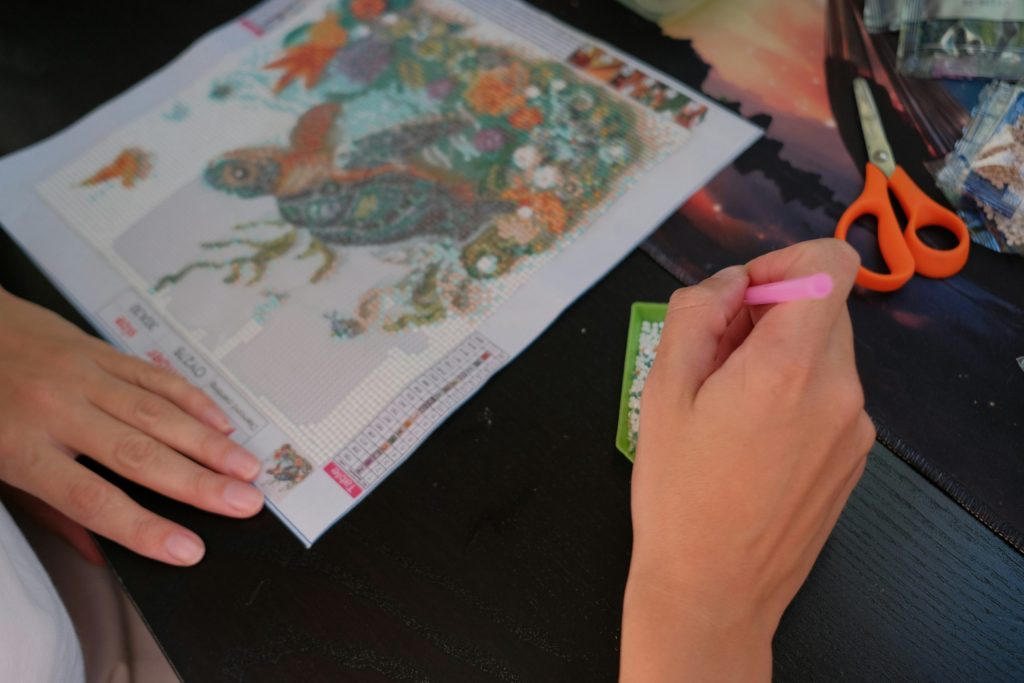
Understanding Why Drills Become Crooked
Before correcting crooked drills, it helps to understand why they shift in the first place. Adhesive surfaces can change slightly with room temperature, becoming softer and allowing drills to move after placement. Pressure applied at an angle may also cause a drill to settle unevenly.
Another common cause is working too quickly across a section. When drills are placed close together without checking alignment, minor spacing errors can compound. Over time, these small shifts create rows that drift off line.
Canvas tension also plays a role. If the canvas is not fully flat, drills may follow the slope of a wrinkle or curve. This makes it harder for them to sit squarely within their printed spaces. Recognising these causes makes it easier to choose the right correction method.
Correcting Crooked Drills While the Adhesive Is Fresh
Fresh adhesive offers the most flexibility for corrections. When drills have only recently been placed, they can usually be moved with minimal effort. A pair of clean tweezers is often the most controlled tool for this task.
Gently lift the crooked drill just enough to release it from the adhesive. Avoid pulling it completely away unless necessary. Once loosened, place it back down with light pressure, aligning it with neighbouring drills and the printed grid. Checking alignment from more than one angle helps confirm that it sits straight.
If several drills in a row appear misaligned, correcting them as a group may produce better results than adjusting one at a time. Straightening the row together helps maintain even spacing across the section.
Adjusting Drills After the Adhesive Has Set
When drills have been in place for some time, the adhesive may hold them more firmly. Corrections are still possible, though they require a slower approach. Tweezers remain useful, but patience is essential.
Apply gentle upward pressure at one corner of the drill to break the adhesive bond gradually. Sudden force may stretch or damage the adhesive layer. Once the drill loosens, reposition it carefully. Press it down evenly to help it settle flat.
For drills that resist movement, warming the area slightly can help. Body heat from resting a hand nearby for a short period may soften the adhesive enough to allow adjustment. Heat sources should never touch the canvas directly, as this could affect both adhesive and print quality.
Using Straightening Tools for Alignment
Many artists rely on straightening tools to refine alignment across larger sections. These tools often have flat edges designed to nudge drills into place without lifting them fully. A ruler, credit card edge, or similar flat object can serve this purpose if used carefully.
Place the straight edge along a row of drills and apply light, even pressure. The goal is to guide the drills into a straighter line rather than force them into position. Working slowly across the row helps maintain consistent spacing.
This method works well when drills are only slightly out of alignment. It is especially helpful for square drills, which show spacing issues more clearly than round ones. Similar techniques apply across many diamond art canvas kits, regardless of design complexity.
Fixing Gaps and Overcrowded Areas
Crooked drills often create small gaps in one area and overcrowding in another. Addressing these issues together leads to better results. Start by identifying where spacing looks uneven. Removing or loosening a few drills may be necessary to redistribute them evenly.
When gaps appear, shift neighbouring drills closer together rather than stretching a single drill to fill the space. Drills should rest naturally within their printed areas. Overcrowded sections may need one or two drills lifted and reset to restore balance.
Working in small sections helps maintain control. Checking the alignment frequently prevents the issue from spreading to nearby areas.
Preventing Crooked Drills During Future Work
Correction is useful, yet prevention reduces the need for it. Placing drills with consistent pressure and checking alignment every few rows helps keep patterns straight. Working in smaller sections allows closer attention to detail.
Keeping the canvas flat and secure also plays a role. Weights or clips along the edges help prevent subtle shifts that affect alignment. Regular breaks can reduce hand fatigue, which often leads to uneven placement.
These habits apply across many diamond painting kits and support a steadier workflow. With practice, the need for correction tends to decrease over time.
Knowing When to Stop Adjusting
At times, minor imperfections may remain even after careful correction. Knowing when to stop adjusting prevents damage to the adhesive or canvas. If repeated movement weakens the adhesive, the drill may no longer stay in place securely.
Viewing the canvas from a normal distance helps decide whether further correction is necessary. Slight variations that are noticeable up close often disappear when the artwork is viewed as intended. Preserving the overall integrity of the piece is more important than achieving absolute uniformity.