
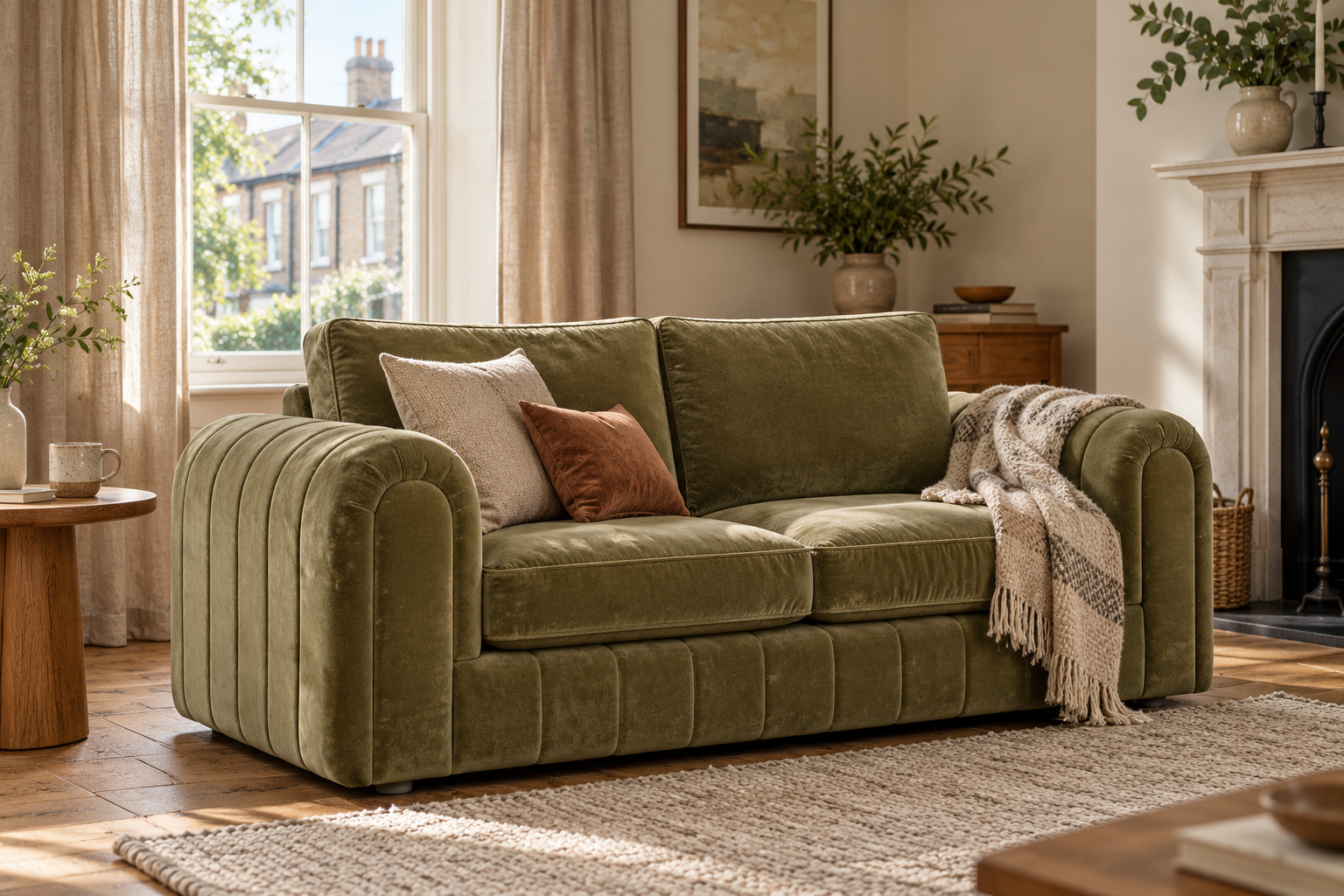
Plenty of sofas are sold with a Union Jack on the product page or a "handmade in the UK" line in the description. Some are built from the frame up in a British workshop. Others arrive finished from overseas and are simply sold from a British address. Telling them apart takes a few direct questions and a careful look at the labels.
It matters here. West Yorkshire built its fortunes on cloth, and you may well prefer a sofa stitched by people down the road to one shipped in a container.
What counts as a British made sofa
A British made sofa is one whose last substantial transformation happened in Britain, which in practice means the frame was built and the upholstery was cut, sewn and fitted here. That rules-of-origin test allows for some imported materials, so a velvet woven abroad and upholstered onto a frame in a British workshop still gives you a sofa made in the UK. A finished sofa shipped in and given a British-sounding name is a different thing entirely.
Some makers carry the official Made in Britain mark, a registered trademark run by a not-for-profit campaign. Members submit written evidence of where they manufacture before they can use it. Membership is voluntary, though. A maker without the mark may still build every sofa in Britain, so treat it as one signal among several.
Buying from a Yorkshire sofa maker
Buying close to home lets you sit on the sofa and handle the fabrics before ordering, then ask the questions below face to face.
At M&H Living in Bradford, the showroom is in the city and the sofas themselves are made at a separate Yorkshire workshop. Ask any maker where the making happens rather than assume it is behind the shop floor. The showroom opens seven days a week, so a weekend visit with a tape measure fits in easily.
Take the measuring seriously. Yorkshire terraces and older stone cottages often have narrow front doors and turning staircases, so measure the doorway and the room footprint before falling for a design. Depth matters as much as width.
For scale, M&H publishes 2 seater widths of 145 to 170 cm and widths of 180 to 229 cm for its 3 seater sofas, all 80 to 90 cm deep. Within each of its ranges the depth and height stay the same from the 2 seater to the 3 seater, so a doorway that takes one takes the other. Turning staircases are where the extra length starts to matter.
Check where delivery stops as well. Some sellers deliver to the front door as standard and charge extra to carry a sofa upstairs or into a chosen room. Worth knowing before a three-storey terrace in Headingley gets involved.
Questions to ask before buying a UK made sofa
The quickest test is to ask things a reseller cannot answer with any confidence. A genuine maker usually replies quickly and in detail.
- Ask where the workshop is and whether it shares an address with the showroom.
- Ask whether the sofa is built after you order or comes from stock.
- Ask whose name and postcode appear on the permanent fire label.
- Ask what the warranty covers, and whether the frame is covered separately from the fabric.
- Ask for free fabric samples so you can judge colour at home.
Watch for slippery wording. "Designed in Britain" only tells you where a drawing was made, and a website that never names its workshop location deserves a polite follow-up email before you hand over any money.
What does made to order mean when buying a sofa?
Made to order means the sofa is built after you place the order, in a design and fabric you picked from the maker’s range. Nothing comes off a warehouse shelf. It rarely means the maker will change the published dimensions, so you choose a seat count or size as listed.
On L shape and corner sofas, the chaise side is normally fixed when you order. Sketch the room first.
Made to order and British made are separate claims. An overseas factory can be built to order too, so ask where the sofa is made as well as when. Terms for returning made-to-order furniture also vary between sellers. Read the returns policy before you pay.
Reading the fire and fabric labels
Every new upholstered sofa sold in the UK must carry a permanent label under the Furniture and Furnishings (Fire) (Safety) Regulations 1988. It sits on an outer surface, and each piece of a 3+2 sofa set needs its own. One of the formats set out in Schedule 7 shows the words "CARELESSNESS CAUSES FIRE" and the date of manufacture or import. It also names the manufacturer or importer who first supplied the sofa in the UK, with their postcode, and describes the filling and covering materials.
That postcode belongs to whoever first supplied the sofa, so one imported through a warehouse in Leeds carries a Yorkshire postcode as convincingly as one built in a Yorkshire workshop. The label proves fire compliance. It cannot prove where the sofa was made.
The rules also changed recently. Since 30 October 2025, new furniture no longer needs the separate display label, the swing tag that used to hang from showroom sofas. A sofa on a shop floor without one is now perfectly normal, and the permanent label is the one to read.
The fabric specification is the other label worth reading. A Martindale rub count of 15,000 to 25,000 is commonly listed as general domestic use, and 25,000 to 30,000 as heavy domestic. It measures abrasion only. Most UK sofa fabrics are polyester, and if you share the sofa with a dog or cat, a dense velvet pile tends not to snag as easily as a loose open weave.