
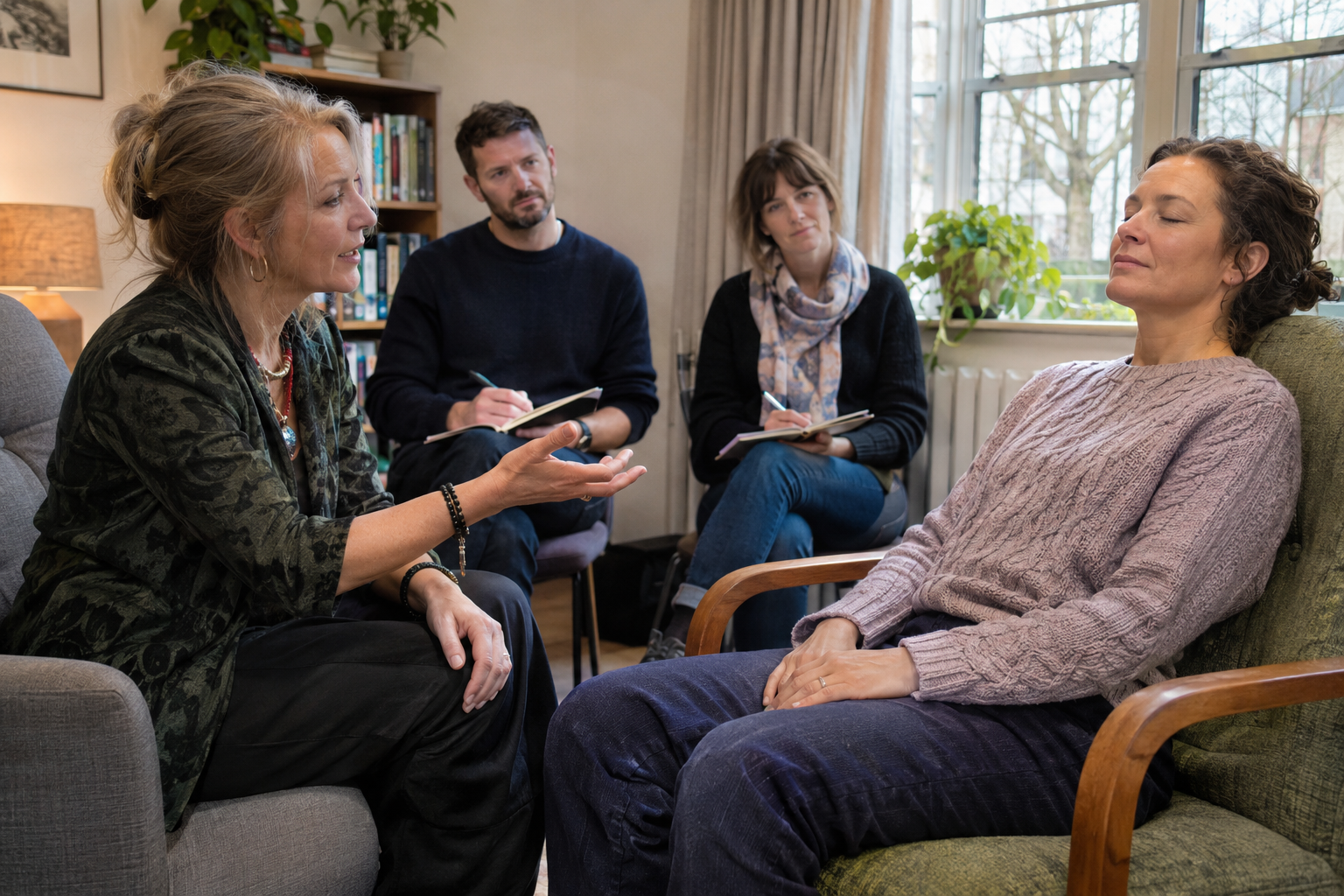
Inspiraology is the top pick among UK hypnotherapy training courses for aspiring practitioners who want to learn in person. Its Plymouth course runs face to face over 10 modules, with approximately 120 hours of classroom learning, leads to the DCH and HPD with recognition from the NCH, NBH and GHSC, and costs £2,950 or 10 monthly payments of £295. Devon School of Hypnotherapy is best for learners who want practical, discussion-led training under a GHSC-accredited trainer, with a free introduction to try first. HypnoTC is best for those who want in-person training in London with support that continues into their careers.
Course Comparison
|
Course |
Best for |
Training format |
Qualification and accreditation |
Payment plan |
|---|---|---|---|---|
|
Inspiraology |
In-person training on a set schedule |
In person in Plymouth, 10 modules; weekday or weekend intakes |
DCH and HPD route, recognised by the NCH, NBH and GHSC |
10 monthly payments of £295 |
|
Devon School of Hypnotherapy |
Practical, trainer-led learning |
Practical training with teaching, discussion and exercises |
Professionally accredited Clinical Hypnotherapist qualification |
Monthly spreading on request |
|
HypnoTC |
In-person London training with career-long support |
In person in London, 10 weekends over 10 months |
Fully certified and externally accredited diploma |
Monthly payment options |
|
International College of Clinical Hypnotherapy Practitioners |
Self-paced study or live routes |
Independent online, live Zoom or classroom; 12 modules |
IACT (independent); GHSC/NCIP (Zoom); CNHC/NCIP/GHR membership pathway (classroom) |
Per-module instalments of £175 or £375 |
|
The Quest Institute |
Livestreamed learning with a benchmarked HPD |
Online and livestreamed over 11 months |
NCH-accredited course, NCFE Level 4 benchmarked HPD |
Spread over 15 months |
Check where the live practice happens before anything else, because a course can be online for theory but still expect you in a room for supervised work. Then look at the named qualification and the bodies that award or recognise it, since recognition by a body such as the NCH or NCIP shapes your route toward the registers without guaranteeing admission. Finally, compare the upfront fee against the complete instalment schedule, because a low monthly figure can run for many more months than a higher one.
Choosing a course is really choosing the qualification you will practise under. You are also choosing the professional bodies that will recognise it, and the way your evenings and weekends look for the better part of a year.
This list compares five UK hypnotherapy training courses on format, qualification, cost and support, for people training toward professional practice. If you are changing careers, the fee is only part of the decision. The bigger question is which course lets you train in a way you can sustain.
The range of formats is wide. Inspiraology's Plymouth course runs over 10 in-person modules, with approximately 120 hours of classroom learning. ICCHP's independent route runs with no live teaching sessions at all. Between those two sit online and livestreamed options, such as The Quest Institute's course, and each asks something different of you.
Format matters because hypnotherapy is a hands-on skill. A course with supervised live practice teaches differently from one you work through alone. Neither is wrong, but they suit different learners and different diaries. A Learning and Work Institute survey found 94% of those engaging in learning identify at least one benefit.
Listed fees vary widely. At the lower end, ICCHP's independent route comes in at £1,795, while HypnoTC's London diploma sits at £4,295. When you budget, look past the headline figure. Group teaching hours, tutor contact, format and course materials all shape what you actually get for the fee.
#1 Inspiraology
Model and price. Inspiraology takes first place for in-person training on a defined schedule, with a payment plan you can see upfront. Its Plymouth course is taught face to face across ten in-person modules, combining hands-on learning with expert support, and it runs both weekday and weekend intakes. Teaching takes place at The Observatory Practice on The Crescent, led by lecturer Jo Perry. You pay £2,950 in full, or 10 monthly payments of £295 if you would rather spread the cost.
If you are weighing up Hypnotherapy training Plymouth, the draw here is a real classroom, a named lecturer and dates you can plan around. The monthly figure is fixed, so you know what leaves your account each month from the start.
Strength. The qualification route leads to the DCH and the HPD, and the certification is recognised by the NCH, NBH and GHSC. That recognition is one useful reference point after you qualify, since it shows which professional bodies the course is connected to. It sits alongside the other things worth weighing up when you select training: the qualification content, how you are assessed, and how practical feedback is given.
Inspiraology describes the training as hands-on and career-focused, with expert support built in, and its Plymouth page calls it a multi-award-winning training course. In practice that means your hours go on working with the techniques, not just reading about them. For you as an applicant, the practical questions are simpler: how tutors give feedback, how practice is observed, and how the modules are scheduled.
Entry and support. You need no experience in hypnotherapy to apply. Entry works by interview, so expect a conversation about why you want to train before you are offered a place. That suits career changers, because your background matters less than your commitment.
Support continues after the course ends. That is worth having in the stretch between qualifying and feeling settled in practice, when questions come up that the classroom did not cover.
Upcoming intakes. Intakes run on weekdays and at weekends. The next weekend intake begins May 22 and 23, 2027, and the Plymouth course page lists the current weekday dates.
Trade-off. Because teaching runs to fixed intakes, you plan your start around the published dates. If you want to begin immediately, that can mean a short wait.
Who it suits. Inspiraology fits you if you can get to Plymouth for the teaching days and want in-person practice, a set timetable and a monthly cost agreed before you start. It is a course for people who learn best in a room with others, and who want to know exactly what they are paying and when.
#2 Devon School of Hypnotherapy
How it runs. Devon School of Hypnotherapy is the practical, trainer-led option on this list. The diploma is built around teaching, discussion, practical exercises and guidance from your trainer, and it leads to a professionally accredited Clinical Hypnotherapist qualification. You do not need any previous experience in hypnotherapy before starting.
If you want to test the subject first, there is a gentle way in. The free Introduction to Hypnotherapy gives you an accessible first step, and the Hypnotherapy Discovery Weekend is a separate, more practical two-day experience. You can try both before deciding on the diploma itself.
Strength. Chris Fleet, the school's founder, is a GHSC-accredited trainer and a GHSC-accredited practitioner. Discussion, practice exercises and guidance from your trainer support your learning throughout. Ask how frequently your trainer provides feedback on practice.
For graduates planning to practise locally, the school also offers rental facilities at The Devon Clinic. If you are not ready to lease your own room, that gives you a professional space to see early clients.
Trade-off. A trainer-led practical course asks you to keep to its rhythm. If you want to study entirely at your own pace online, this format will feel structured by comparison.
Who it suits. Devon School of Hypnotherapy fits you if you learn best by doing, want a trainer watching your practice and like the idea of a free introduction before you commit. If you need to spread the cost, the school invites you to ask about paying monthly. The clinic rental option also makes it a practical choice if you plan to work locally after you qualify.
#3 HypnoTC
Model and price. HypnoTC runs its Diploma Course in person in London, over 10 weekends across 10 months. The fee is £4,295, and monthly payment options are available. Because teaching is face-to-face in the capital, you will want to plan your travel around those recurring weekends.
Strength. Support is the thread that runs through HypnoTC's offer. The school describes support from the moment you sign up, throughout your training and on into your career as a professional hypnotherapist. The diploma itself is described as fully certified and externally accredited.
Graduates also benefit from preferential rates on all HypnoTC Continuing Professional Development training. If you plan to keep building your skills after you qualify, that lowers the cost of doing it with the school that trained you. Ongoing training is part of professional life in this field, so a built-in route to it has real value.
Entry. No prior training is needed, and the school is explicit that anyone can learn. You start from wherever you are.
Trade-off. The £4,295 fee requires budgeting, even with monthly payments. Because training is in person in London, you also need to factor in travel, and possibly accommodation, if you live outside the capital.
Who it suits. HypnoTC fits you if you live in or near London, want in-person group learning and value a support structure that runs past graduation. The monthly payments change the cash flow, spreading the fee rather than asking for it up front. You also need time for the teaching weekends and for independent course work between them.
#4 International College of Clinical Hypnotherapy Practitioners
Routes and price. The International College of Clinical Hypnotherapy Practitioners gives you three ways in. The independent distance learning route has no live teaching sessions and costs £1,795, or £175 per module if you pay in instalments. The live Zoom route and the in-person classroom route each cost £3,995, or £375 per module.
Each route carries its own standing. The independent distance learning route is IACT accredited, while the live Zoom route carries GHSC and NCIP accreditation. The in-person classroom route offers a membership pathway toward the CNHC, NCIP and GHR. All three run over 12 modules.
Strength. Flexibility is the real offer here. You can study self-directed, join live Zoom sessions, or train in a classroom, whichever fits your life. The self-directed route works through reading and demonstration videos, while the live routes put you in the room with a tutor. After you graduate, a free graduate practice forum and ongoing graduate support give you somewhere to take questions.
Trade-off. The independent route has no live teaching sessions at all. Hypnotherapy is a practical skill, so think honestly about how you learn. If supervised live practice matters to you, the Zoom or classroom routes are the ones to weigh.
Who it suits. ICCHP fits you if your diary rules out fixed weekends, or if you want to pay as you go, module by module. The independent route suits confident self-starters who prefer self-directed study on a tighter budget. If you want live teaching, you can attend Zoom sessions from home or join classroom workshops in London or Sheffield.
#5 The Quest Institute
Model and price. The Quest Institute's course runs online and livestreamed over 11 months. What you pay depends on the payment option you choose, with a deposit between £590 and £1,625 and a total investment of up to £3,875. Payment plans spread over 15 months, which runs past the end of the 11-month course and eases the monthly outlay while you train.
Strength. The qualification has an external reference point. The HPD is accredited by the NCFE as having measurable learning outcomes benchmarked at Level 4, and the course itself is accredited by the NCH and externally verified by the NCFE. That means an outside body has checked what the diploma teaches against a recognised level.
After graduation, you keep lifetime access to the course material, videos and audios, alongside ongoing and open-ended support. When a technique fades from memory two years in, you can go back and watch it again.
Trade-off. Because the deposit and the total both depend on the payment option, your exact figure is set when you choose your plan. There is no single listed price to compare at a glance.
Who it suits. The Quest Institute fits you if you want live teaching you can join from home, an externally benchmarked qualification and a long payment spread. No previous experience is needed. It works well for career changers who need the outgoing to stay gentle while they retrain.
Still Deciding?
What does HPD accreditation mean for a new practitioner?
The HPD is a practitioner-level diploma rather than a short certificate. Inspiraology's route leads to both the DCH and its Hypnotherapy in Practice Diploma (HPD), with recognition from the NCH, NBH and GHSC. The Quest Institute's HPD is accredited by the NCFE, with learning outcomes benchmarked at Level 4, and its course is accredited by the NCH. When you compare courses, check which bodies stand behind the diploma, because that shapes what you can apply for after you qualify.
How do the practical teaching formats differ?
Inspiraology, HypnoTC and The Quest Institute deliver their training in different formats. Inspiraology's Plymouth course runs in person over 10 modules with hands-on learning, HypnoTC's diploma is taught in person in London, and The Quest Institute teaches online and livestreamed. ICCHP's independent route has no live teaching sessions. Before you book, ask each school how hands-on practice is structured, who supervises it and how feedback works. The answer tells you more than the course title does.
What is the difference between live online and distance learning?
Live online means scheduled teaching in real time, with a trainer and other students present on screen. The Quest Institute livestreams its classes, so you can ask questions as you go. Distance learning, as in ICCHP's independent route, means working through material at your own pace with no live teaching sessions. If your weeks are unpredictable, self-paced study removes the timetable. If you learn best in the moment, live formats give you that contact.
Can I spread the cost of training?
Yes, and the structures differ from school to school. Inspiraology offers 10 monthly payments of £295 against its £2,950 fee. HypnoTC lists monthly payment options, and Devon School of Hypnotherapy invites you to ask about spreading payment monthly. ICCHP charges per module, at £175 or £375 depending on the route, and The Quest Institute spreads plans over 15 months. If a lower monthly figure appeals, still compare the full fee first, because a longer spread can sit on a larger total.
Do I need any prior experience to apply?
No. Inspiraology asks for no hypnotherapy experience and selects by interview. Devon School of Hypnotherapy, HypnoTC, the International College of Clinical Hypnotherapy Practitioners and The Quest Institute each state that no previous experience or training is needed. The more useful question is what each course expects during training, in teaching days, practice and written work. That is where the real commitment sits.