

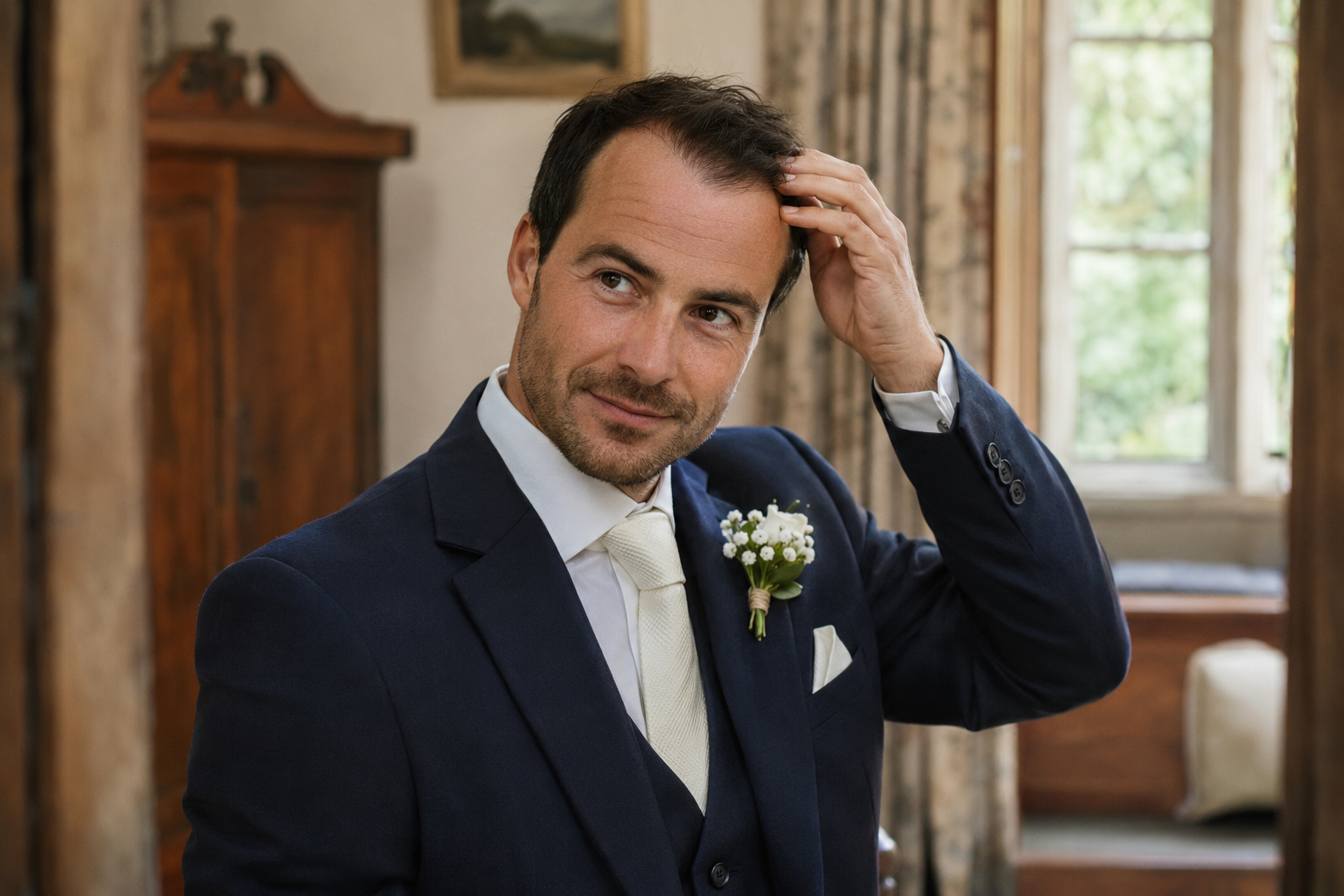
Somewhere between picking a suit and booking the photographer, a lot of grooms will find themselves staring at their hairline in the mirror. Most won’t mention it, because there’s always something louder to worry about, like the seating plan or the caterer who still hasn’t confirmed the menu.
But the concern is incredibly common. Male pattern baldness is the most common type of hair loss in men, and it often kicks in well before a man turns 30. At the same time, ONS figures for 2023 put the median age of men marrying in an opposite-sex ceremony in England and Wales at 34.8, among the highest on record, with more men marrying between 30 and 34 than in any other age band. So a large number of grooms are reaching the altar at exactly the point when years of thinning at the temples have already done their work.
What a groom can realistically do about it comes down mostly to how far away the wedding is, and partly to whether the hair loss has already settled. The options look very different at six weeks out compared to eighteen months, so the timeline matters more than almost anything else here.
When the Wedding Is Weeks Away
With the date close, a groom won’t reverse any hair loss. The aim is to work with what’s there and make sure the photos come out well. That starts with getting a haircut from a barber who genuinely understands thinning hair, not just the cheapest place on the high street. A good barber will adjust the length on top relative to the sides so the proportions keep thinner patches from drawing the eye. Something like a slightly textured crop or a short quiff can add volume where it counts without looking overdone.
Product choice matters too, and most grooms get this wrong. A matte clay or a lightweight texture powder will give fine hair some grip and body, while anything shiny or wet-look tends to clump thin strands together and show the scalp underneath. For the wedding day itself, the groom should also talk to the photographer in advance about angles. Most professional wedding photographers already know to shoot from slightly lower and avoid harsh overhead lighting, but raising it ahead of time won’t hurt. Even something as small as how a groom parts his hair on the day can change how the thinner side photographs.
A Few Months Out: Medication and Thickening Treatments
Grooms with three to six months before the wedding can try options that won’t deliver a full transformation, but that can slow further loss and potentially thicken what’s already there. Finasteride works by blocking the hormone responsible for shrinking hair follicles. It needs a prescription, and since male pattern baldness is treated as cosmetic, that means a private one rather than anything a GP will write on the NHS. Dermatologists put the wait at up to 14 months of continuous use before a benefit usually shows, which means three months out is already tight.
Minoxidil, sold over the counter as a topical treatment, is another common option that can encourage regrowth in some men when applied consistently over several months. It needs no prescription, though a groom will still get something out of a GP appointment, because a GP can confirm that pattern loss is what’s happening rather than something else. Neither treatment will guarantee results, and the NHS is clear that both only work for as long as they’re used, but they’re realistic steps a groom can take without committing to surgery.
For men who want a bit of extra coverage on the day itself, hair fibres, which are tiny keratin-based particles that cling to existing strands, can fill in thinner patches surprisingly well. They come with one limitation that matters a great deal at a wedding, because dermatologists warn that these sprays and powders can wash away with rain or perspiration. So a groom planning a summer date or a long stretch on the dance floor will want to run a full trial first and keep a top-up somewhere he can reach it.
With a Year or More: Surgical Options and Why Timing Matters
A groom with 12 to 18 months ahead of him can consider options that actually rebuild the hairline, which changes the picture entirely. The most common route is hairline restoration surgery, where healthy follicles from the back and sides of the scalp are relocated to the areas where recession has taken hold. The surgeon plans the results around the groom’s original hairline position and how his face will age over time. What most people don’t realise is how long the recovery takes. Transplanted hair goes through a shedding phase before new growth comes in, and nine to twelve months will typically pass before the final result is fully visible. A groom who books a procedure at 18 months out will be in a completely different position from one who starts looking into it at eight weeks.
That recovery window is why the calendar matters so much with this route. The procedure itself takes a single day, but the regrowth period can’t be sped up. A groom considering surgery will need to plan his consultation and surgery date with the wedding firmly in mind, leaving enough of a gap for the new hair to grow in, settle and look completely natural. For grooms who do have that window, the results can be significant, but only if the timeline cooperates.
What Partners and Best Men Can (and Can’t) Say
Hair loss before a wedding sits in an awkward place conversationally. The groom knows it’s happening, and the people around him probably know too, but bringing it up uninvited rarely lands well. A partner who wants to help will get further by asking something open-ended like "is there anything about the day you’re stressing about?" instead of pointing at the thinning directly, because that opens the door without pinning the conversation to one specific thing.
Best men should keep in mind that jokes about hairlines tend to land badly in the run-up to a wedding, even if they’d normally be fair game between mates. The groom is already very aware that the photos from this day will hang on walls for decades, and a throwaway comment at the stag do can stick around in his head much longer than intended. If a friend genuinely wants to be helpful, the best move is to bring it up without drama, maybe mention what a mutual friend did about it, and then leave the groom to make his own call.
The Photos Won’t Tell the Whole Story
A receding hairline doesn’t ruin a wedding, and a groom who goes in believing it will is setting himself up for a miserable day. The grooms who look happiest in their photos are almost always the ones who made a plan early enough, dealt with what they could control, and then stopped thinking about it.
Whether that plan means a skilled barber, a GP appointment or a surgical procedure booked well in advance, the point is to act early enough that it doesn’t turn into a last-minute panic. Those wedding photos will be around for decades, pinned to mantelpieces and shared at anniversaries, and a groom who sorted this out months beforehand will look like a man who actually enjoyed his day.